When the Newspaper Arrived by Post
Newspaper delivery by post made distance visible: learn how to read an issue’s date, address and condition to judge its timing and context.
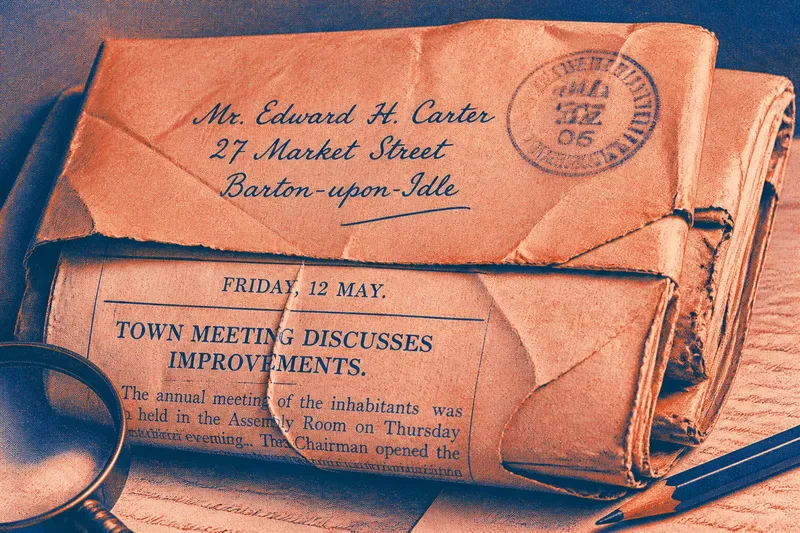
The common mistake is to treat newspaper delivery by post as a simple delay between printing and reading. That misses what a surviving issue can actually tell us: its date, address and physical condition may offer clues about its intended reader and the journey it took, while leaving many details unknown.
What can a surviving issue tell us?
Start with the object in front of you, not a general story about postal practice. A printed date identifies the issue’s stated publication day; it does not, by itself, tell you when the paper was posted or delivered. An address written on a wrapper can identify a recipient or destination, but it cannot establish how the paper reached its final stop.
Look for marks that belong to that particular copy: a postal cancellation, a delivery label, folds, tears or signs of a wrapper. Record what is visible before drawing conclusions. If a mark is unclear, describe it as unclear rather than assigning it a route, date or meaning that the object does not confirm.
Historical postal arrangements differed across places and periods. Without a documented source tied to the specific newspaper, location and date, avoid claiming that a paper was routinely sold at a post office, carried with other mail or delivered to a subscriber’s home. Those possibilities are not evidence about every copy.
How did postal circulation affect reading?
A paper that travelled to a distant reader could be opened after its printed date. The interval matters when considering a report about a fast-changing event: the issue may preserve what the paper said at publication, but it cannot tell us when a particular reader saw it unless delivery evidence survives.
This distinction separates publication from reception. The date on the page is evidence of the issue’s stated timing; a reader’s actual encounter is a separate event. A careful account keeps those facts apart and avoids describing a paper as either fresh or stale without a clear basis for comparison.
Postal circulation could also make the newspaper a physical item to keep, share or revisit. Whether a specific reader did so is usually not visible from the printed contents alone. Treat it as a possibility, not a fact about an unknown household.
How should you examine a mailed newspaper?
- Check the printed date; if it is legible, use it as the issue date, and if it is missing or damaged, state that the date cannot be read.
- Check for an address or name; if one is present, transcribe it cautiously, and if none is visible, do not infer a subscriber.
- Check for a postal mark; if its wording and date are clear, describe what they say, and if they are unclear, do not assign a route or delivery day.
- Check for a wrapper or label; if it remains attached, note its material and visible markings, and if it is absent, do not assume the paper travelled unwrapped.
- Check the folds and damage; if they cross the printed pages, record their position, and if their cause is unknown, do not attribute them to a particular journey.
- Check whether the issue names a place or event; if it does, compare that wording with the issue date, and if timing is uncertain, describe the report without calling it late or current.
Say you are examining an invented copy dated 12 May, with a legible name and address on its wrapper, a blurred postal mark and a crease through a report about a town meeting. First, record 12 May as the printed issue date. Next, transcribe the visible address without claiming that its recipient lived there. Then note that the postal mark cannot be read, so the posting and delivery dates remain unknown. Finally, record the crease but do not connect it to the route. The sound conclusion is limited: this issue was prepared for an addressed destination, but the surviving evidence does not establish when it arrived or when its reader encountered the meeting report.
What questions help interpret newspaper delivery by post?
Does the printed date show when a reader received the paper?
No. It identifies the date printed on the issue, not the day a particular copy was posted or delivered. A clear postal mark may add evidence, but it still needs careful interpretation.
Can an address prove that someone subscribed?
An address shows that the copy was directed to a named destination if the writing is legible. It does not alone establish a subscription, payment arrangement or the identity of the person who read it.
Can a postal mark reveal the full route?
Usually, a visible mark supports only what it explicitly records. Do not turn an incomplete or ambiguous mark into a complete itinerary.
How can you judge whether a report was out of date?
Compare the issue date with a reliably established date for the event or later development. If either date is uncertain, describe the gap as unknown rather than labelling the report late.
Why does this distinction matter?
Newspaper delivery by post is best understood through the evidence each copy preserves. Separating an issue’s publication date from its unknown delivery date helps readers avoid turning plausible postal habits into unsupported history.
When describing a mailed newspaper, keep a short record of what is visible and what remains uncertain. That distinction gives future readers something more useful than a confident story: a clear account of the object, with room for better evidence to change the interpretation.