The Assignment Meeting Before the First Interview
An assignment meeting turns a broad subject into a clear reporting question, a defined audience and a workable plan before the first interview.
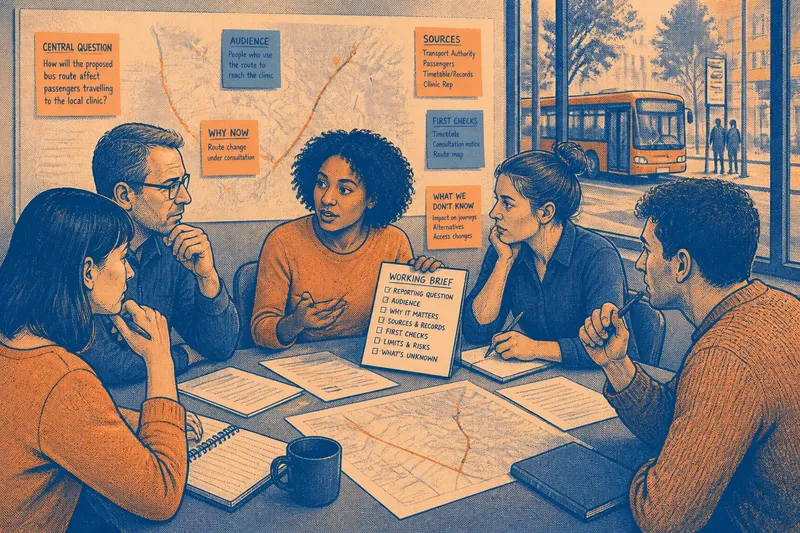
The common mistake in an assignment meeting is approving a subject before agreeing what the story needs to find out. “The new bus route” sounds like a story, but it might concern a service change, access or practical travel information. That vagueness costs reporting time: interviews begin without a shared purpose, and useful answers may arrive too late to shape the piece.
A useful assignment meeting turns the subject into a question, identifies the reader who needs an answer and sets out a route to evidence. It does not settle the conclusion. It gives the reporter and editor a clear starting point, while leaving room to change course.
What should an assignment meeting produce?
It should produce a short working brief, not a finished argument. Record the reporting question, intended reader, reason to publish, likely sources, first checks and practical limits. Note what remains unknown, too.
That brief helps a reporter use an interview well. Instead of asking a source to explain a broad subject from the beginning, the reporter can test a specific uncertainty. The editor can also see whether new material answers the assignment or points towards a different story.
Keep the brief somewhere the reporting team can consult, such as a shared document or the newsroom’s assignment system. The format matters less than making the decisions visible to everyone commissioning, reporting, editing and producing the story.
How do you turn a broad subject into a reporting question?
A subject names a territory. A reporting question identifies something not yet understood and points towards evidence that could clarify it.
“The new bus route” is a subject. “How will the proposed route affect passengers travelling to the local clinic?” is a more useful question, if the proposal and clinic connection can be checked. It suggests people to approach, records to seek and a public consequence to examine.
Avoid wording that builds in a verdict. “Why has the council abandoned passengers?” assumes both abandonment and motive. A more open question asks which journeys may change, who could be affected and what reasons the council gives. That wording allows several answers to remain possible.
Write down the premise separately. If it is uncertain, decide how to check it before the reporting plan depends on it. A timetable, public notice or route map may establish whether the proposed change is real and what it involves.
Who is the story for, and what do readers need?
Name the audience in practical terms. “Everyone” gives the team little direction. A clearer audience might be people who use a particular service, residents trying to understand a local change or readers following a public decision.
The intended reader helps the newsroom decide what needs explaining, which unfamiliar terms need translation and what questions the story should answer. Passengers may need clear route details. Readers examining the decision-making process may need to know who had authority and which alternatives were considered.
Ask what a reader should understand after reading. Keep the answer concrete. The story might clarify what is proposed and where uncertainty remains; it need not resolve every dispute about transport policy.
Which sources and records belong in the plan?
Choose sources for the knowledge they can offer, not their status alone. An official may explain a decision and point to records. Someone affected can describe a particular journey. A specialist may interpret technical details, while documents can establish dates, rules or stated reasons.
For the clinic route question, a starting plan might include the transport authority, passengers using the relevant stop, the published timetable and a clinic representative. Each has a distinct role. One person’s account can describe their experience; it cannot, on its own, establish how widely that experience is shared.
Plan to test the first framing, too. If the authority says the proposal is intended to improve access, seek the basis for that claim and ask people whose journeys may become harder. Note whose perspectives are missing, especially when the easiest sources to reach are not necessarily those most affected.
How much should you plan before interviews begin?
Plan enough to start, but leave room to revise. Identify the first records to check, the first people to approach, the likely format and any deadline or access constraint. Do not script every question or decide the conclusion in advance.
Say you are assigned to examine a proposed change to the bus route serving a clinic. You and the editor agree to check the public timetable and consultation notice, contact the transport authority and ask passengers how they make the journey. The notice says the change is still under consultation, and the timetable shows the current service remains in place. You therefore describe a proposal and investigate its possible effects, rather than reporting that a change has already taken effect. The trade-off is a less immediate claim but a more accurate account of what the records establish.
Changing the assignment in response to evidence is part of reporting, not a failure of the meeting. The brief is a reasoned starting point; new information can narrow, redirect or stop the story.
Which questions should an assignment meeting settle?
What is the central reporting question?
Write one sentence that evidence could answer, even if the eventual answer remains uncertain. If it relies on an accusation or unverified premise, mark that premise for checking before building the plan around it.
Who needs this story, and why now?
Name the intended reader and the immediate reason the subject matters to them. The reason might be a decision, change or public deadline, but the team should establish it rather than assume it.
What evidence could change the story?
List records, observations or accounts that could confirm, complicate or undermine the initial idea. This gives the reporter a reason to follow evidence that does not fit the original pitch.
What could stop you answering the question?
Identify likely access problems, missing records, limited time or an unresponsive source. Then decide whether to narrow the question, seek another route to the evidence or pause the assignment.
When should you change or stop the assignment?
Revisit the brief when its basic premise fails, a source points towards a materially different question or the available evidence cannot support the promised answer. Make any change explicit so the headline, format and reader expectation do not remain tied to an abandoned idea.
The result may be a smaller story or a short account of what is known and what remains unclear. If the central claim cannot be established, interviews and publication are not ends in themselves.
A strong assignment meeting leaves the reporter able to explain the question, the reader and the route towards evidence. That is the value of an assignment meeting before the first interview: it does not promise an answer, but it makes clear what an answer would need to rest on.