A Transcript or a Short Audio Clip?
A transcript or a short audio clip can each clarify a spoken exchange; learn when to use each and how a simple review routine preserves context.
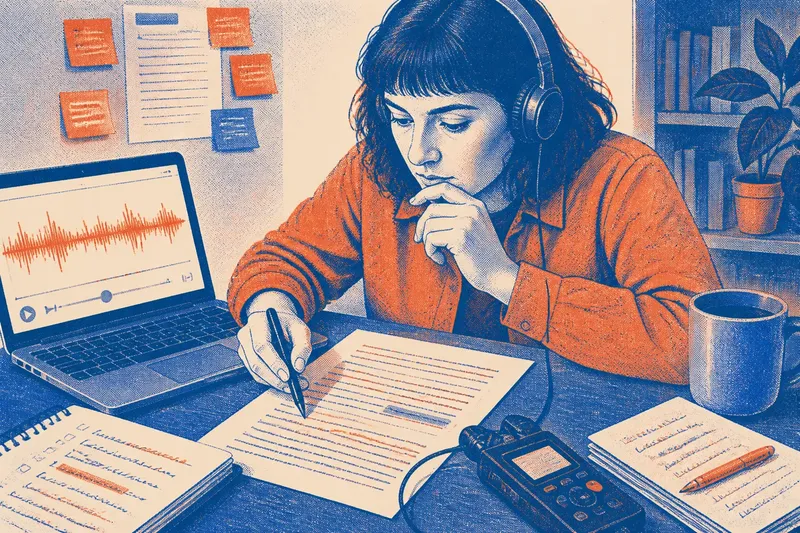
The common mistake when revisiting an interview is to treat a transcript as a complete record of what was said. It preserves words in a form that is easy to search, but can flatten hesitation, interruption and emphasis. A short audio clip restores some of that texture, while cutting away the surrounding exchange can create a different distortion. Choosing between a transcript or a short audio clip is less a matter of ranking them than of matching each to the question you need to answer.
A useful routine begins with the transcript as a map and returns to audio where delivery or context matters. That approach makes it easier to find the relevant passage without letting a neatly edited excerpt stand in for the whole conversation.
What does each format preserve?
A transcript makes spoken language visible. You can scan a long interview, search for a name, compare repeated terms and check the wording around a particular claim. It is especially useful when you want to see whether a speaker said “I think”, “we decided” or “the report says”. Those differences can carry substantial meaning.
Yet written text has to represent speech through conventions. A transcript may use punctuation to suggest pauses or sentence boundaries that were not so clear in the room. It can omit overlap, false starts or quiet acknowledgements. Even a careful verbatim transcript cannot convey every shift in tone through words alone.
Audio preserves audible qualities that text tends to lose: a pause before an answer, a sharp interruption, a laugh, a change in pace or a speaker’s apparent uncertainty. It also lets a listener hear how one remark followed another. But audio is harder to skim, and a short excerpt may hide the question, qualification or correction that gives a sentence its proper sense.
Neither format is automatically more faithful. Each records a different part of the exchange, and each has its own blind spots.
How should you review an exchange over a week?
A week-long review can suit a reporter, editor or reader checking a consequential passage without repeatedly replaying an entire recording. The rhythm matters more than the calendar: first locate the passage, then listen in context, then check the record once more after a pause. Keep the transcript and audio linked to the same source so the words and the sound do not drift apart.
- First session: mark the question. Read the transcript around the passage you need. Mark the question asked, the answer, and any nearby follow-up. Do not begin by copying a striking sentence into a draft without its prompt.
- Next session: listen to the wider passage. Play the recording from before the question through the response and the next turn. Note interruptions, pauses and corrections, but do not infer an emotion or motive from a vocal cue alone.
- Middle of the week: check the wording. Compare the written version with the audio. Pay particular attention to negations, names, numbers, pronouns and words that are easy to mishear. If the transcript marks a phrase as unclear, replay it rather than silently filling the gap.
- Later session: review the proposed excerpt. If you plan to share audio, listen to the clip from its intended start to finish. Then return to the longer passage and ask what a listener would miss without the surrounding question or response.
- Final session: make the format choice. Decide whether the point depends chiefly on exact wording, audible delivery, or both. Keep the transcript available even if audio is published, and describe any edit that materially changes the sequence or removes a qualification.
This pacing creates room to notice an assumption that may slip by during an immediate listen. It also helps separate the actual recording from the interpretation a listener brings to it.
What should you do when the formats disagree?
Start by locating the exact difference. Is a word missing from the transcript? Does punctuation make a pause look like a full stop? Has an editor removed a question that changes what an answer appears to address? These are distinct problems, and replaying the audio while reading the relevant lines can help identify which one applies.
Suppose you are reviewing an invented interview in which a guest says, “I wouldn’t call it settled,” then pauses before explaining that a decision remains under discussion. The transcript makes the sentence easy to quote, while a short clip containing only that sentence sounds more final than the wider exchange. You could preserve the qualification in the written account and, if sharing audio, include enough of the explanation for listeners to hear the caveat. The observable result is that both versions retain the reservation instead of letting an edit erase it.
If the words remain genuinely unclear, mark them as uncertain rather than choosing the version that best fits a story. A transcript may be corrected as the recording is checked; retain a note of what changed, especially when a disputed phrase is central. For material intended for publication, the applicable recording consent, house policy and local rules depend on the circumstances, so check the relevant guidance where needed.
Which format fits the question you have?
A transcript is usually the more workable starting point when the task is to locate wording, compare passages or make a careful written quotation. Audio is more useful when the point concerns delivery, timing, interruption or the relationship between turns. If the question concerns both wording and sound, use both rather than asking one format to answer for the other.
Consider the intended reader, too. Someone checking a specific claim may need searchable text and a clear indication of where the quotation sits. Someone assessing whether an answer was interrupted may need the recording, not a transcript that simply assigns each line to a speaker. A short clip can be accessible and convenient, but a transcript can let a reader revisit a phrase without searching through a recording.
When a transcript is machine-generated, treat its text as a draft for checking, not as an independent confirmation of the recording. Speaker labels, names and short words can be wrong, particularly where voices overlap or the recording is unclear. The more consequential the passage, the more carefully its wording should be compared with the audio.
What do readers often ask about transcripts and clips?
Is a transcript more accurate than a recording?
They preserve different things: a transcript offers readable wording, while a recording preserves audible delivery and sequence. Accuracy depends on the question, the quality of the source and whether the transcript has been checked against it.
How much audio should a short clip include?
Include enough to make the question, answer and relevant qualification intelligible. There is no universal cut length; the right boundary is the one that does not make a remark appear to mean something different from the exchange.
Can punctuation change the meaning of a transcript?
Yes. Punctuation can make a pause appear to end a thought or can make separate clauses seem closely joined. When the distinction matters, check the recording and avoid presenting editorial punctuation as though it were audible fact.
Should an audio clip always accompany a transcript?
No. A clip may add little when the issue is simply exact wording, and an excerpt can mislead if it lacks context. Pair them when the sound itself helps readers assess the exchange, and explain the clip’s limits.
How can you make the record easier to revisit?
Keep a simple source note with the recording, transcript version, speaker labels and the passage used. A time marker or a clear paragraph reference lets another editor return to the same point without hunting through the whole file. If an excerpt is edited, retain the unedited source and record the cut so the published version can be compared with its context.
For a transcript or short audio clip, the most useful choice is the one that lets a reader check the particular feature at issue without disguising what the format cannot show. Search the text for the words; listen for the exchange around them; keep the connection between both. That small discipline turns a memorable line back into part of a conversation.