How to Read a News Headline Without Overstating the Story
Learn how to read a news headline without overstating the story by checking its claims, caveats and evidence before you share or repeat it.
The common mistake with a news headline is to read it, form a view and move on. That can leave you reacting to a claim the article itself narrows, attributes to someone else or leaves unresolved. Treat the headline as a prompt to check what the reporting actually establishes.
What does the headline’s main verb mean?
A headline often compresses a complicated account into a short phrase. Rather than treating that phrase as settled fact, ask what would need to be true for it to be accurate. If a headline says a council “backs” a proposal, does that mean councillors approved it, a committee supported it, or an official merely spoke in favour?
Look in the opening paragraphs for the person, organisation or document behind the headline’s central verb. Then check whether the story describes a completed decision, a recommendation, a prediction or an intention. Those are different claims, even when a tight headline makes them sound alike.
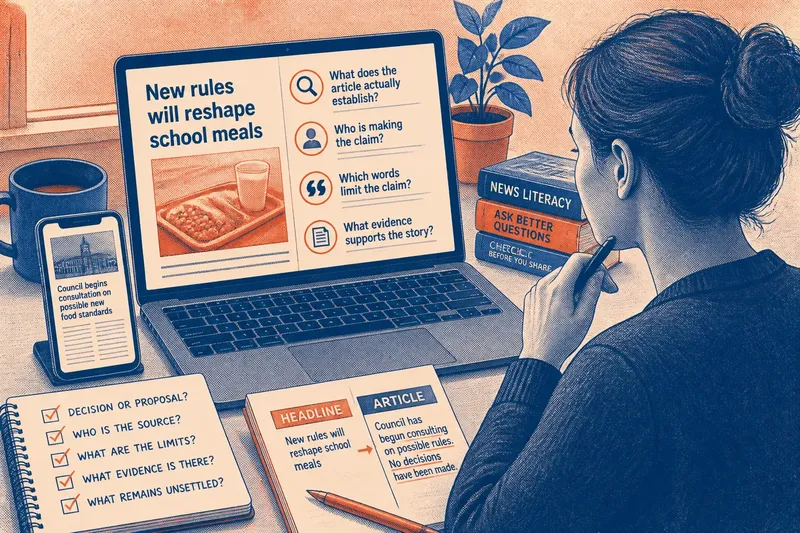
Say you see the invented headline “New rules will reshape school meals”. Imagine the story’s opening says a council has begun consulting on possible rules. The reporting supports a narrower account: discussion has started, but no new rules have been adopted. The headline prompted the question; the article supplied the qualification.
What does the article actually establish?
Read the opening, then look for a paragraph that states what the reporting establishes. Ask what you could repeat to another person without adding certainty that the story does not support.
Keep the central claim separate from its context. A report might establish that a service is being reviewed while also explaining that no final decision has been made. “The service is under review” is supported; “the service is closing” is not, unless the article says closure has been decided.
Put the claim into plain words before sharing the story. If your version uses a stronger verb, refers to a broader group or draws a firmer conclusion than the article, return to the relevant passage. That pause can catch errors created by hurried reading.
Who is making the claim?
A headline may present a claim in the publication’s voice, while the article attributes it to a minister, campaign group, company or witness. Attribution tells you whose statement is being reported; it does not, by itself, establish that the statement is true.
Look for verbs such as “says”, “claims”, “argues” and “warns”. Notice whether the reporter independently verifies the assertion, gives evidence for it or asks another source to respond. A quotation can be accurate as a quotation while the claim inside it remains disputed or incomplete.
Also distinguish a source’s expertise from the scope of their knowledge. A transport operator may know how its own network works, but that does not automatically settle what a proposed policy will do across the country. Check what the source can speak to and where the article supplies context.
Which small words limit the claim?
Words such as “may”, “could”, “some”, “in one area” and “according to” can carry much of a story’s meaning. Headlines may leave them out for space, so check the article for the boundaries they set. A possible outcome is not a confirmed one; a finding about a particular group does not automatically apply to everyone.
Pay attention to comparisons. “Higher than last year” may refer to one measure, one location or one period, rather than a general rise across every relevant measure. Ask what is being compared, over what span and on what basis. If the article does not explain this, that limits what you can safely infer.
Numbers and technical terms need the same care. Check what a figure counts: people, events, applications or something else. A headline can be literally accurate yet misleading if the measure underneath it is narrower than readers are likely to assume.
What kind of evidence supports the story?
A report may draw on documents, data, direct observation, interviews and specialist commentary. These do not all support a claim in the same way. Check what the article presents as evidence, what it attributes to a source and what it offers as interpretation.
For a document-based story, ask what the document records. A draft can reveal a proposal without showing that it has been adopted. Meeting minutes can establish that a topic was discussed, but not that everyone present agreed. For a data-based story, look for the stated source and method, and note any uncertainty or gaps the report describes.
Detail is not proof of the headline’s broadest reading. Several vivid accounts may illustrate a problem without showing how common it is. A narrow piece of evidence, on the other hand, may strongly support a precise claim. Match the strength of your conclusion to the evidence described, not to the confidence of the headline.
What should you check before repeating a headline?
Does the story report a decision or a proposal?
Look for when a decision was made and who had authority to make it. If the article describes consultation, discussion or a recommendation, repeat that status rather than presenting the outcome as settled.
Is the claim attributed to a source?
Find the source and read how the report handles the assertion. Unless the article verifies it independently, describe it as that source’s claim rather than as an established fact.
What qualification changes the scope?
Check who, where, when or how the claim applies. Preserve those limits in your summary, especially when a headline sounds broader than the reporting.
What evidence supports the central point?
Identify whether the story relies on records, data, observation or testimony, and what each can show. If the article does not provide enough detail to settle a point, leave it open rather than filling the gap yourself.
How should you handle unresolved details?
Some reports do not resolve the question a headline raises. Sources may disagree, records may be incomplete or an event may still be unfolding. A careful reading does not require you to pick the most confident account. It requires you to notice what is known, what is attributed and what remains unsettled.
When sharing a story, you can make that distinction in a short sentence: “The report says the proposal is being considered, not that it has been approved.” That is more useful than repeating a dramatic headline or dismissing the whole report because its opening line feels too broad.
If the article corrects or updates an earlier account, read the note and check what changed. An update may add a response, clarify a date or revise a claim. The current version is the one to rely on, while the change itself may explain why an earlier interpretation no longer fits.
How does a headline fit into the whole story?
A headline directs attention, signals the subject and gives you a reason to read on. Its brevity is also a constraint: it cannot carry every source, condition and uncertainty that a careful account needs. Treating it as an entry point lets the headline and the article do their separate work.
When you read a news headline, ask what the reporting actually establishes. The answer may support the wording, qualify it or leave part of it unresolved. Read that answer before forming or passing on a judgement; and if a detail remains unclear, preserve that uncertainty rather than turning it into a firmer claim.